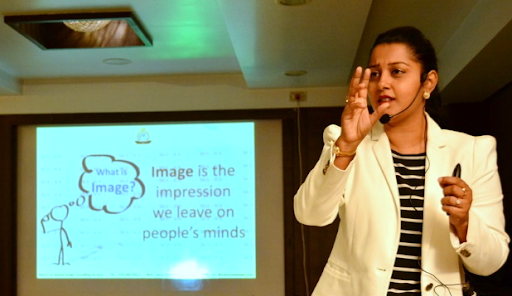
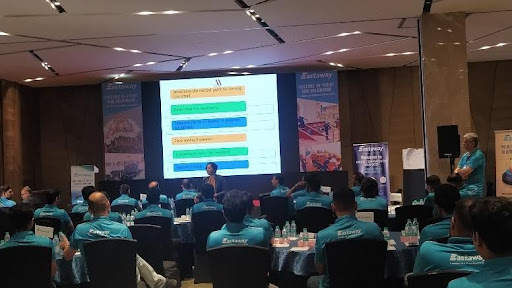
In today’s day and age, Presentation Skills are a must. Presentation skills are about how you present your ideas to an audience, how you get them engaged, and how you convince them to take action. Wait! There’s more! Beyond this, Presentation Skills are about clarity in thinking, organization, and time management. None of us are born with it. We can all learn it by training, experience, and observation.
Learning Outcomes: I) Developing an impactful presentation II) Time Management III) Managing obstacles IV) Handling questions V) Fear management VI) How to sell through presentations
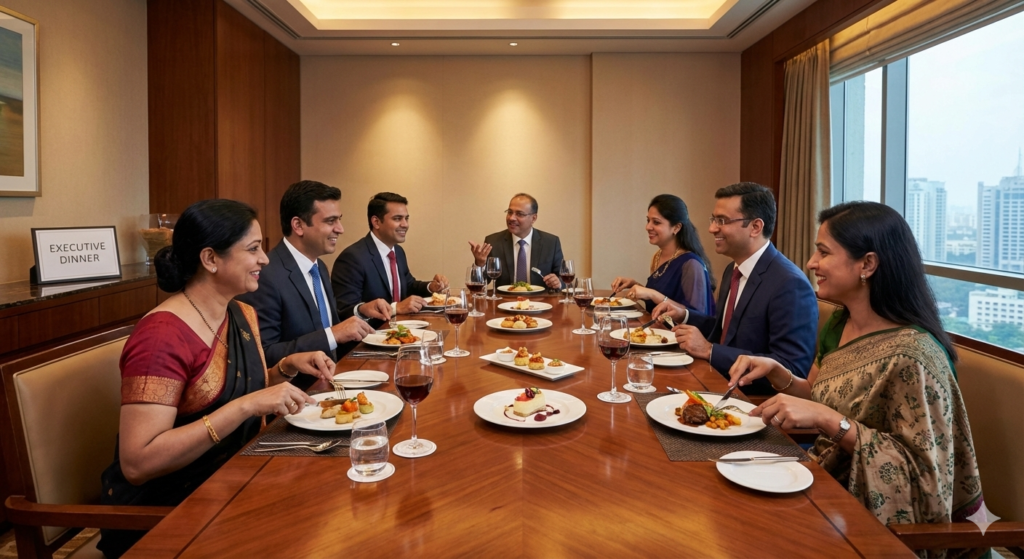
Why do we need to learn Dining Etiquette? Silently, without saying a word, Dining Etiquette shouts out loud your ability to respect and handle people and circumstances; cleanliness, hygiene, and organization; and people management. No one’s born with the knowledge of Dining Etiquette. No one’s born with the knowledge of how to handle cutlery, eat gracefully, handle glassware with élan, and the like. It’s a skill that can be learned. Right training makes it a lifetime learning on handling food, drinks, and people.
Learning Outcomes: I) What to do and not do at the dining table II) Principles of handling food III) Navigate different food courses IV) Proper use of utensils and cutlery V) Navigate seating as per your role – host, guest, guest of honour VI) Ordering and consumption of drinks
The written word carries its value worth in gold. Written communication makes all matters clear. It reduces ambiguity, gives a clear direction to the reader on the action to be taken. It serves as a record and reference for the future. Written communication also holds true in the court of law. To have functions running smoothly, it’s worth the while to invest in written communication.
Learning Outcomes: I) Understanding the purpose II) Understanding the audience III) Defining the action to be taken IV) Inclusions and exclusions V) Editing VI) Email Features
The manner in which your employees present themselves at the workplace speaks about how well the organization’s doing. Employees’ self-presentation matters to customers, vendors, shareholders, media, investors, internal teams, and all those associated with the organization internally and externally. Employees’ self-presentation has an impact on the employees themselves too. Along with that, it also influences organization culture. The right Business Grooming helps employees, and the organization at large, gain more respect. Business Grooming for the workplace is a simple equation of various permutations and combinations of five Components. We help your employees decode this equation. So your employees are groomed for business.
Learning Outcomes: I) The role of self-presentation in business II) Understanding outfits as per roles, goals, and occasions III) 5 elements of business outfits IV) How to choose the right clothes, accessories, and footwear V) Business Formals & Business Casuals VI) Style Scale VII) Business colours and social colours VIII) Matching accessories and footwear to clothes IX) Professional Grooming essentials
If you’re in HR, you will know how difficult it is to get employees to follow the dress code policy. Many employees struggle to understand the true purpose behind their organization & dress code policy — seeing it as a rule, not realizing its a reflection of the company’s identity, values, and professionalism. Drafting the dress code policy is one thing. Getting employees to follow it, another. We help you ensure your employees adhere to the dress code policy with ease and consistency. Employee empathy + an HR initiative is a fool-proof plan to get everyone to follow the dress code policy.
Learning Outcomes: I) Formal outfits and casual outfits for the workplace for all occasions II) Right fits for the workplace III) Compliance in outfit with safety and legal standards, if any IV) Right colours for your industry V) Accessories and footwear best suited to your organisation, gelled with personal choices VI) Self-care
Business Etiquette is one of the surest ways to build Trust. Business Etiquette is made up of 3 pillars – (a) Respect for people (b) Respect for processes and resources (c) Respect for time When you train your team in Business Etiquette, every team member absorbs and practices respect. Respect leads to Trust. Continuous practice of respect solidifies Trust. A trusted workplace is a loved workplace. Employees love coming to work when they know they’re respected and trusted.
Learning Outcomes: I) How to conduct oneself in a team II) Use of words and actions that demonstrate professionalism III) How to handle office resources IV) Mastering Client & Visitor Etiquette V) Management of the work desk VI) How to conduct oneself during company-sponsored events
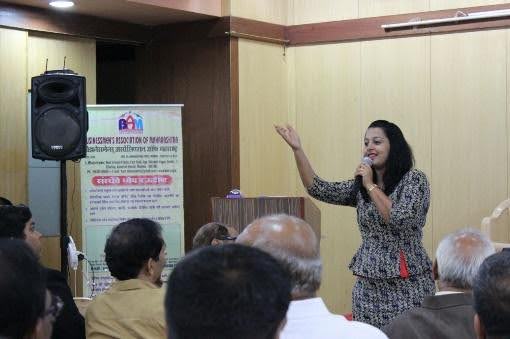
Whether it’s giving a briefing to your team, or welcoming your Managing Director, or detailing your products and services to your customers, you need Public Speaking everywhere. Good Public Speaking skills help your team members cast positive impressions about the organization. It boosts their self- confidence. We help you with a Magic Formula that helps you draft memorable speeches in minutes. Good Public Speakers aren’t born, they’re made. Research, drafting, and practice, all go into making a good Public Speaker.
Learning Outcomes: I) How to create mesmerizing speeches II) Non-verbal communication during speeches III) Time management IV) Handling questions from audiences V) Practical learning
Today, an organization’s first impression is on social media. It speaks organizational proficiency, builds the brand, positions the organization as a captivating place to work, builds employer brand, influences and increases marketing sales, opens doors to customer interactions, and much more. Social media training includes what to post and what not to post on social media, responsibility allocation of social media, training on the social media policy.
Learning Outcomes: I) The need to connect with organisational brands on social media II) Engage with customers, address concerns, and build positive relationships III) Create engaging, shareable content that aligns with the company’s goals IV) Sharing positive company news, products, or experiences with personal networks V) Use of tags VI) Organizational growth on social media VII) Build and maintain personal brand on social media, which can enhance professional reputation and career growth VIII) Network with industry peers and thought leaders
International travel for business is a reality for most businesses. International travel training helps you better navigate circumstances, people, and eventualities. It helps you acclimatize, network, and build bonds. It lowers communication barriers and builds Trust. International Travel Training helps in closing overseas business deals, building relationships, and demonstrating respect for the local culture.
Learning Outcomes: I) Decoding culture – words, body language, greetings, festivals, events, celebrations, dress codes, religious customs, gender differentiation II) Managing time zones III) Workplace culture – team management across boundaries, managing employees from different soils IV) Culture Shock